CDD Basics: How Shared Decision Graphs Compress Non-Convex Symbolic Sets
This page continues naturally from Federations: Exact Unions Of DBM Zones. Federations already show that finite unions of DBMs can represent non-convex sets exactly. CDDs push on the next question: once a verifier accumulates many related non-convex pieces, can they be stored as one shared decision structure instead of as a long flat DBM list? [UPP_VER_CDD] [BEHR03_CDD_PAGE] [UCDD_REPO].
That is why the most direct way into CDDs is to start with the shared-graph idea itself. CDDs reuse that idea, but apply it to clock-difference constraints rather than only to boolean conditions.
This page connects four layers:
how BDDs use shared graphs to represent condition structure
how CDDs transfer that idea to clock-difference constraints
why explicit DBM lists become a bottleneck in verification workflows
what the current UCDD and
pyudbm.binding.ucddlayers expose, and what those operations mean algorithmically
From BDDs To CDDs: Why Shared Graphs Matter
BDD Intuition: Shared Decision Graphs
A binary decision diagram is best understood first as a structural idea.
Its core move is simple: represent a boolean function as a shared DAG rather than as a fully expanded decision tree or truth table.
For example, consider
Evaluating this function means answering a sequence of boolean questions:
is \(a\) true or false?
then perhaps inspect \(b\) or \(c\)
finally reach a
TrueorFalseterminal
![digraph bdd_basics {
rankdir=LR;
graph [pad="0.2", nodesep="0.7", ranksep="0.42", splines=true];
node [shape=circle, style="filled", fillcolor="#f7f7f7", color="#666666", fontname="Helvetica"];
edge [color="#666666", fontname="Helvetica"];
a [label="a"];
b [label="b"];
c [label="c", fillcolor="#eef4ff", color="#5c7fb8"];
t [shape=box, label="True", fillcolor="#eef8ee", color="#5b8a5b"];
f [shape=box, label="False", fillcolor="#fff1f1", color="#aa5555"];
a -> c [label="1"];
a -> b [label="0", style=dashed];
b -> c [label="1"];
b -> f [label="0", style=dashed];
c -> t [label="1"];
c -> f [label="0", style=dashed];
}](../../_images/graphviz-f36ce27d3386e0a42c767e8f64c69ed2d49e80bf.png)
The most important thing to notice is the shared c node. Two different
paths reuse the same suffix instead of duplicating it. That is exactly what
makes the diagram useful as a data structure rather than just as a picture.
For this tutorial, the most useful BDD-level picture is just this:
it represents a boolean function
each inner node asks about one boolean variable
edges typically mean
0/1orFalse/Truethe structure is a shared graph, not a tree with all suffixes copied
With that in mind, the move to CDDs becomes natural:
BDD inner nodes test boolean variables
CDD inner nodes test which interval contains one clock difference
BDD edges are labeled by
0/1CDD edges are labeled by intervals
So a CDD reuses the same structural idea of ordered decisions, shared suffixes, true/false terminals, and reduced graph maintenance, but swaps boolean-variable tests for clock-difference interval tests.
Why Look Beyond Explicit Federations
With that BDD intuition in place, the motivation for CDDs becomes much less abrupt.
In WAIT / PASSED style reachability, the real pressure point is not whether one individual zone can be represented, but whether all zones already seen at one control location can be stored and queried as one compact symbolic object.
The CDD paper makes the relaxed stopping condition explicit [BEHR03_CDD_PAGE]:
In words:
\(D\) is the newly generated zone
the relevant question is whether location \(l\) is already covered collectively by what is in
PASSEDif yes, expanding \(D\) again is unnecessary
An explicit federation still writes this as
which is semantically fine. But once non-convexity becomes strong, three costs become visible:
the number of DBM pieces may grow quickly
structurally similar tails cannot be shared across pieces in a plain list
the practically important question is often “is this new zone included in the whole non-convex object?”, not “is one DBM equal to another?”
That is where CDDs enter: they bring the shared-graph intuition of BDDs into the clock-constraint world, encoding finite unions of zones as a shared DAG instead of a permanently flattened DBM list [BEHR03_CDD_PAGE] [UCDD_CDD_H].
![digraph explicit_vs_shared {
rankdir=LR;
graph [pad="0.2", nodesep="0.45", ranksep="0.75", splines=true];
node [shape=box, style="rounded,filled", fillcolor="#f7f7f7", color="#666666", fontname="Helvetica", fontsize=10];
edge [color="#666666", fontname="Helvetica", fontsize=10];
subgraph cluster_left {
label="Explicit federation / DBM list";
color="#cfcfcf";
style="rounded,dashed";
l0 [label="D1\n0<=x-y<=2\n0<=x<=1\n0<=y<=2"];
l1 [label="D2\n0<=x-y<=2\n4<=x<=5\n0<=y<=2"];
l2 [label="D3\n4<=x-y<=6\n0<=x<=1\n0<=y<=2"];
l3 [label="D4\n4<=x-y<=6\n4<=x<=5\n0<=y<=2"];
lu [label="Same non-convex set\nD1 U D2 U D3 U D4", fillcolor="#eef8ee", color="#5b8a5b", width=1.8];
l0 -> lu;
l1 -> lu;
l2 -> lu;
l3 -> lu;
}
subgraph cluster_right {
label="Shared CDD";
color="#cfcfcf";
style="rounded,dashed";
r0 [label="x - y"];
r1 [label="x"];
r2 [label="y", fillcolor="#eef4ff", color="#5c7fb8"];
rt [label="True", fillcolor="#eef8ee", color="#5b8a5b"];
rf [label="False", fillcolor="#fff1f1", color="#aa5555"];
subgraph cluster_suffix {
label="shared suffix";
color="#b9cde5";
style="rounded,dashed";
r2;
rt;
rf;
}
r0 -> r1 [label="[0, 2]"];
r0 -> r1 [label="[4, 6]"];
r0 -> rf [label="otherwise"];
r1 -> r2 [label="[0, 1]"];
r1 -> r2 [label="[4, 5]"];
r1 -> rf [label="otherwise"];
r2 -> rt [label="[0, 2]"];
r2 -> rf [label="otherwise"];
}
}](../../_images/graphviz-0880656576301746b45adf6935a241185d8b2980.png)
Both sides of this diagram represent the same non-convex set:
where
The left side writes this as four explicit DBMs. The right side rewrites the same constraints as a shared decision graph:
first test whether \(x-y\) lies in
[0,2]or[4,6]then test whether \(x\) lies in
[0,1]or[4,5]finally enter the dashed shared-suffix box, where \(y \in [0,2]\) is checked once
So the point is not just that “the right side has sharing”. It is that for the same set, the explicit federation repeats the suffix condition \(y \in [0,2]\) inside all four DBMs, whereas the CDD keeps that suffix once and lets multiple earlier branches point to it.
From the current Python wrapper perspective, this is not just historical
background. pyudbm.binding.ucdd now exposes CDD.from_federation(),
CDD.contains_dbm(), CDD.extract_dbm(), and
CDD.extract_bdd_and_dbm() directly [PYUDBM_UCDD_PY] [PYUDBM_UCDD_CPP].
That makes the “CDD <-> DBM / federation” bridge a real user-facing workflow.
The Core Definition: Nodes, Intervals, and Semantics
The paper-level definition can be compressed into one sentence: a CDD is an ordered reduced DAG whose inner nodes inspect one clock difference and whose outgoing edges are labeled by intervals for that difference.
Fix a type
and let
denote the constraint saying that \(X_i - X_j\) lies in interval \(I\).
Then an inner node does not ask a yes/no question about one boolean variable; it asks: which interval contains the current value of one clock difference?
The semantics can be written as [BEHR03_CDD_PAGE]:
So evaluation is path-based:
inspect the clock difference attached to the current node
follow the unique interval edge matching the current valuation
accept the valuation if the path ends in
True
This is also where the main difference from ROBDDs shows up. Clock-difference constraints are not independent. Bounds on \(X\), \(Y\), and \(X-Y\) interact. That is why the paper emphasizes that CDDs do not gain a simple canonical form just by fixing an order and applying sharing [BEHR03_CDD_PAGE].
The definition therefore includes extra structural requirements:
successor intervals of one node must be pairwise disjoint
they must cover the real line
the graph must respect the global order on types
the reduced form uses maximal sharing and avoids trivial full-line edges
Later the paper introduces tightened and equally fine partitioned CDDs. The key normal-form statement is [BEHR03_CDD_PAGE]:
but only under those extra hypotheses. For practical understanding, the important takeaway is not “CDDs are automatically canonical”; it is: CDDs share aggressively, but equivalence and normal-form reasoning are more subtle than in ROBDDs.
From The Paper’s Continuous CDDs To Today’s Mixed Symbolic Graphs
If one only follows the original 1999 paper narrative, it is natural to think
of a CDD mainly as “one shared structure compressing many continuous zones at
one location”. That is still true, but it is no longer the whole story for the
current UCDD and pyudbm.binding.ucdd.
In the actual UCDD codebase, BDD levels and clock-difference levels live inside the same runtime and may appear in the same symbolic graph [UCDD_CDD_H] [PYUDBM_UCDD_CPP] [PYUDBM_UCDD_PY].
The public header says this quite explicitly:
the module supports both
BDDnodes andCDDnodesif only booleans are declared, it degenerates to a BDD library
with both clocks and booleans, the total number of levels is \(O(n^2 + m)\): clock-difference levels from clock pairs, plus boolean-decision levels
The low-level API reflects exactly that split:
TYPE_CDD = 0andTYPE_BDD = 1LevelInfoexposestype,clock1,clock2, anddiffcdd_add_bddvar(n)extends the global runtime with boolean levelscdd_add_clocks(n)extends it with clock-difference levels, whose space is \(O(c^2)\)
![digraph runtime_layout {
rankdir=TB;
graph [pad="0.25", nodesep="0.4", ranksep="0.6", splines=true];
node [shape=box, style="rounded,filled", fillcolor="#f7f7f7", color="#666666", fontname="Helvetica"];
edge [color="#666666", fontname="Helvetica"];
ctx [label="CDDContext"];
base [label="base Context\nclock names / order", fillcolor="#eef4ff", color="#5c7fb8"];
bools [label="boolean declarations", fillcolor="#fff8e8", color="#c97a1f"];
runtime [label="global UCDD runtime", fillcolor="#eef8ee", color="#5b8a5b"];
bdd [label="BDD levels\nTYPE_BDD", fillcolor="#fff3de", color="#c97a1f"];
cdd [label="clock-difference levels\nTYPE_CDD", fillcolor="#eaf3ff", color="#4c78a8"];
mixed [label="mixed CDD\nbool + clock", fillcolor="#f6eff7", color="#8c6bb1"];
extract [label="extract_bdd_and_dbm()", fillcolor="#f7f7f7"];
dbm [label="BDD guard + DBM fragment", fillcolor="#eef4ff", color="#5c7fb8"];
fed [label="Federation\n(pure-clock only)", fillcolor="#eef8ee", color="#5b8a5b"];
subgraph cluster_decl {
label="context declarations";
color="#cfcfcf";
style="rounded,dashed";
{
rank=same;
base;
bools;
}
}
subgraph cluster_runtime {
label="runtime layers";
color="#cfcfcf";
style="rounded,dashed";
{
rank=same;
bdd;
cdd;
}
}
subgraph cluster_result {
label="extracted results";
color="#cfcfcf";
style="rounded,dashed";
{
rank=same;
extract;
dbm;
fed;
}
}
ctx -> base;
ctx -> bools;
base -> runtime [label="cdd_add_clocks"];
bools -> runtime [label="cdd_add_bddvar"];
runtime -> bdd;
runtime -> cdd;
bdd -> mixed;
cdd -> mixed;
mixed -> extract;
extract -> dbm;
dbm -> fed [label="if BDD guard = True"];
}](../../_images/graphviz-ac963ff641a73f5901ef4199c8bf10b0043d6076.png)
At the Python layer, this mixed structure is user-facing rather than hidden:
CDDContextstoresbase_context,clock_names,bool_names, anddimensiontogether_ensure_runtime_layoutcalls nativeadd_clocks/add_bddvarsand caches the resultingbool_levelseach
CDDBoolis tied to one native BDD level, andCDDBool.as_cdd()becomesCDD.bddvar()each
CDDClock/CDDVariableDifferencestill uses the DBM-style DSL and then lifts the resulting zone throughCDD.from_federation()
So once you are in the Python DSL, booleans and zones are not two loose
side-by-side objects. They are woven into one symbolic object. For example,
starting from pyudbm.binding.udbm.Context and
pyudbm.binding.udbm.Context.to_cdd_context():
from pyudbm import Context

base = Context(["x", "y"], name="c")
ctx = base.to_cdd_context(bools=["door_open", "alarm"])

state = ((ctx.x <= 5) & ctx.door_open) | ((ctx.y <= 2) & ~ctx.door_open)
This state is not merely “a boolean formula plus a federation”. It is one
mixed graph. Along a root-to-terminal path you may encounter boolean levels and
clock-difference levels together, and the path as a whole defines one boolean
guard together with one zone fragment.
The same example can be written as
If you sketch it as one mixed “boolean layer + continuous layer” object, the shape looks roughly like this:
![digraph mixed_bool_zone {
rankdir=TB;
graph [pad="0.2", nodesep="0.45", ranksep="0.6", splines=true];
node [shape=box, style="rounded,filled", fillcolor="#f7f7f7", color="#666666", fontname="Helvetica", fontsize=10];
edge [color="#666666", fontname="Helvetica", fontsize=10];
b [label="door_open", fillcolor="#fff3de", color="#c97a1f"];
x [label="x", fillcolor="#eaf3ff", color="#4c78a8"];
y [label="y", fillcolor="#eaf3ff", color="#4c78a8"];
t [label="True", fillcolor="#eef8ee", color="#5b8a5b"];
f [label="False", fillcolor="#fff1f1", color="#aa5555"];
subgraph cluster_bdd {
label="boolean layer";
color="#f0d9ab";
style="rounded,dashed";
b;
}
subgraph cluster_cdd {
label="continuous layer";
color="#b9cde5";
style="rounded,dashed";
{
rank=same;
x;
y;
}
}
b -> x [label="true"];
b -> y [label="false"];
x -> t [label="[0, 5]"];
x -> f [label="otherwise"];
y -> t [label="[0, 2]"];
y -> f [label="otherwise"];
}](../../_images/graphviz-4e300a028184f3950d6a41649daa6e015959bb28.png)
This diagram does not claim that UCDD stores the graph in exactly this one
node layout. It visualizes the mixed path semantics of one CDD:
the root tests the boolean variable
door_openthe true branch continues with the clock constraint \(x \in [0,5]\)
the false branch continues with \(y \in [0,2]\)
one graph therefore carries both discrete guards and continuous zone pieces
For the current implementation, the most faithful mental model is:
where \(B_k\) is the boolean guard extracted from one path and \(D_k\) is the associated DBM fragment. That formula is not a verbatim paper definition. It is an implementation-level summary induced directly by the current extraction API:
CDD.extract_bdd_and_dbm()returns onebdd_part, onedbm, and oneremainderCDDExtractionkeeps those three parts as high-level objectsCDD.to_federation()repeatedly extracts fragments and refuses conversion as soon as one extractedbdd_partis notTrue
Together these behaviors almost spell out the runtime model: a mixed CDD represents many “boolean-guarded zone fragments”; a plain federation can only carry the special case where those guards collapse to truth.
So in real UCDD, “zones and booleans coexist” is not a vague slogan. It means:
boolean variables occupy BDD levels
clock-difference constraints occupy CDD levels
both share one global level order and one decision graph
one extracted path becomes “guard + zone fragment”
forward and backward discrete operators can accept both clock resets and boolean resets
Three practical boundaries are worth remembering:
the UCDD runtime is process-global, and the wrapper enforces one compatible clock order plus one compatible boolean-prefix layout at a time
boolean layouts can only grow compatibly by prefix; arbitrary renamings do not coexist in one live runtime
native
extract_*helpers require reduced CDDs, and the Python layer absorbs that precondition automatically [UCDD_CDD_H] [PYUDBM_UCDD_PY]
That is also why CDDs matter here as more than historical background:
they support a more unified Python-first symbolic workflow
they keep the repository from ossifying at the level of explicit DBM federations alone
With that implementation picture in mind, the verification role of CDDs becomes clearer.
What CDDs Are Doing Inside Verification
Placed back inside timed-automata symbolic semantics, CDDs take over three jobs.
First, they turn “many zones at one location” into a first-class object. That
is the story behind formula (1) and behind the paper’s use of a CDD to compress
the continuous part of PASSED.
Second, they aim to support DBM-like symbolic transforms. At the semantic level, the two central operations are still [UPP_SEM_CDD] [BY04_CDD] [BEHR03_CDD_PAGE]:
That is, time elapse and clock reset. The paper’s final section states explicitly that, with tightened CDDs, these operations can be defined along the same overall lines as for DBMs [BEHR03_CDD_PAGE].
Third, CDDs support whole-set boolean and inclusion-style reasoning:
union, intersection, complement
constructing a CDD from a constraint system / DBM
checking whether one zone is included in one CDD
The asymmetric query
is especially important in reachability: one fresh zone \(D\), one accumulated non-convex object \(C\).
Current API And Verification Meaning
API |
Category |
Verification meaning |
Notes |
|---|---|---|---|
|
Bridging |
Move zones / federations into CDD form |
Useful for connecting explicit DBM workflows to shared diagrams |
|
Set / boolean algebra |
intersection, union, difference, xor, complement |
boolean literals and clock constraints live in one graph |
|
Representation maintenance |
reduction and semantic equivalence |
extraction-oriented helpers depend on reduced form |
|
Inclusion |
ask whether a new zone is already covered |
this matches the paper’s most important asymmetric query |
|
Decomposition |
split one mixed graph into guard + DBM fragments |
crucial for interop with DBM / federation code |
|
Boolean inspection |
enumerate satisfying boolean assignments |
especially useful for debugging mixed symbolic states |
|
Time operators |
forward and backward time closure |
align with timed-automata delay predecessor / successor reasoning |
|
Forward discrete-step operators |
guard + clock/bool updates |
|
|
Backward discrete-step operators |
symbolic predecessors of an edge |
directly relevant to backward reachability |
|
Conversion back to explicit union form |
only for pure-clock CDDs |
mixed boolean guards are rejected explicitly |
Understanding The Core Operations In Verification Terms
contains_dbm(): The Question Is Coverage, Not Similarity
For reachability, one of the most valuable questions is
meaning “is this new zone already covered by the accumulated symbolic object?”
This is not a symmetric equality test. It is an incoming zone versus old
CDD inclusion query. Section 4.2 of the paper treats exactly this as a key
operation, and the current Python API exposes it as CDD.contains_dbm(dbm)
[BEHR03_CDD_PAGE] [PYUDBM_UCDD_PY].
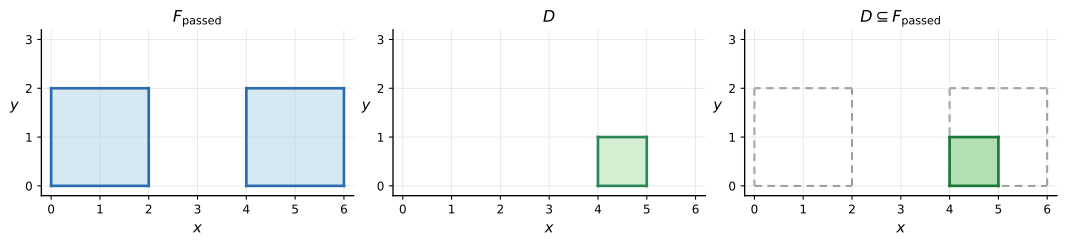
The rightmost panel illustrates the practical meaning: if the candidate zone is already inside the accumulated non-convex set, expanding it again usually adds no new timing information.
reduce() and extract_*(): Splitting A Shared Graph Into Guards And DBMs
For the current wrapper, a useful operational view is
This is an inference from the current extraction API rather than a verbatim
paper definition: repeated extract_bdd_and_dbm() calls peel one boolean
guard \(B_k\) plus one DBM fragment \(D_k\) at a time until the
remainder is empty.
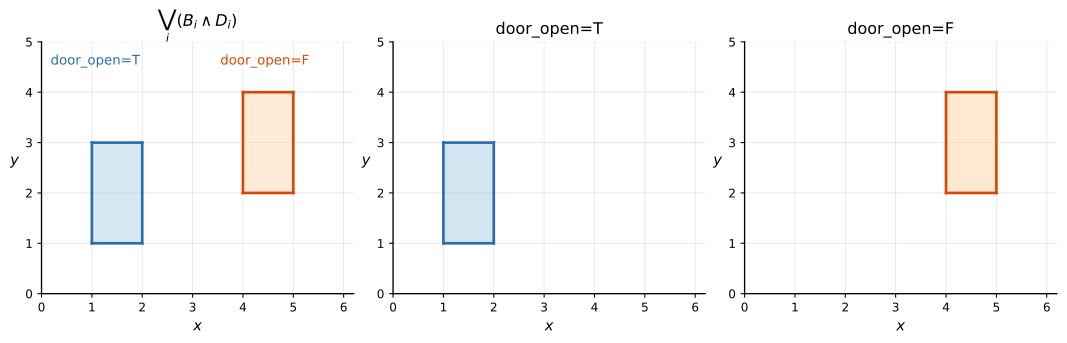
This matters because:
it provides a clean bridge back into existing DBM / federation algorithms
it exposes how boolean guards carve the continuous state space into pieces
It also clarifies a hard boundary: if a CDD still has a non-trivial boolean guard, it cannot be converted directly to a plain federation.
delay() and delay_invariant(): Time-Successor Operators
Timed-automata forward time semantics are still
So delay() should be read as: push the whole symbolic state forward in
time while staying in the same discrete control point.
delay_invariant(I) adds the requirement that the invariant \(I\) remain
satisfied during that time passage. That makes it the more direct fit for
location-invariant reasoning.
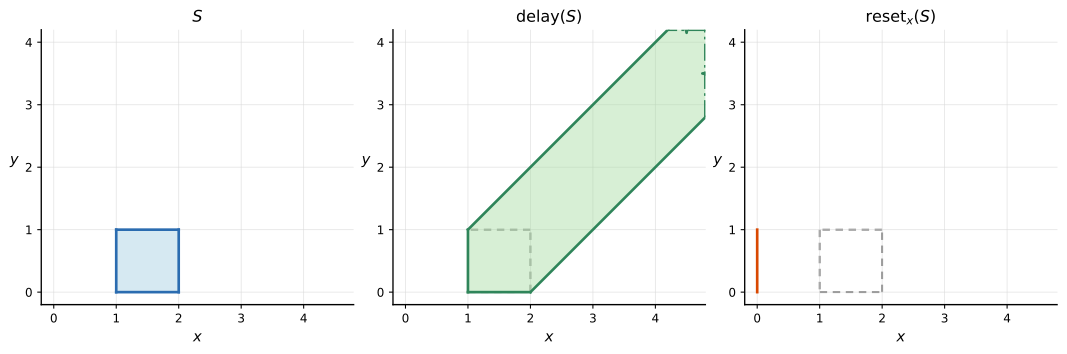
The middle panel shows why this is a symbolic-state operator rather than a single-state simulator step: a small bounded region can expand into a much larger slanted band once all admissible time elapses are taken together.
apply_reset() and transition(): A Discrete Edge Is A Symbolic Transform
At the symbolic level, a discrete edge has the shape
where \(g\) is the guard. The current transition() method packages
exactly that pattern: intersect with a guard, then perform clock and boolean
updates [PYUDBM_UCDD_PY] [PYUDBM_UCDD_CPP].
In verification terms:
guardfilters valuations that can actually take the edgeclock_resetsimplement clock updates on that edgebool_resetsimplement the discrete-side updates at the same step
This is also where the current wrapper goes beyond the paper’s original continuous-only PASSED story: discrete guards and continuous constraints can be combined in one graph first, then advanced together through one transition.
past(), predt(), transition_back(), transition_back_past()
Forward reachability is only one half of the story. Backward search, safe predecessor reasoning, and some fixpoint algorithms need inverse-time and inverse-edge operators as first-class tools.
past() is the easiest one: it is the backward counterpart of delay().
predt(safe) can be interpreted as
This is an inference from the current naming, tests, and the way the operator
is combined with a safe region, rather than a literal wrapper comment. Under
that reading, predt asks which states can reach the target through time
while staying inside the safe region the whole way.
transition_back() and transition_back_past() then push that idea across
discrete edges:
transition_backcomputes symbolic predecessors of a discrete steptransition_back_pastalso closes the result under inverse time elapse
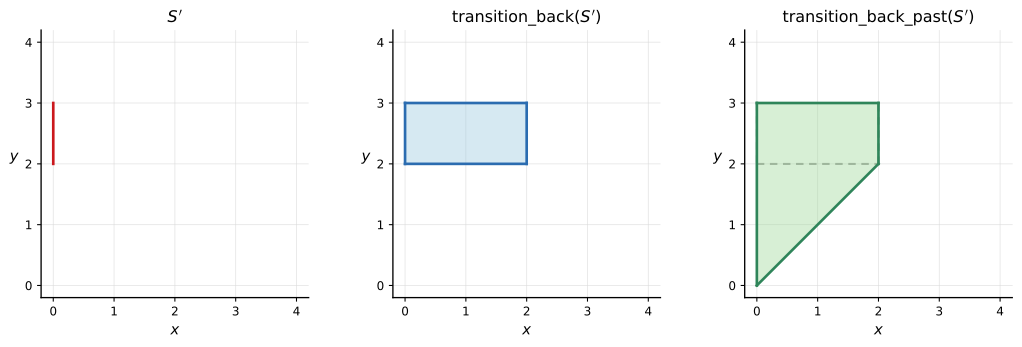
The third panel being larger than the second is exactly the point: first invert the edge, then add earlier time-predecessor states as well.
Important Takeaways
If this page leaves you with seven core points, they should be these:
Federations answer exact non-convex representation; CDDs answer sharing, compression, and whole-set querying.
The basic decision unit of a CDD is an interval over one clock difference, not a single boolean bit.
CDD structure is BDD-like, but it should not be explained as if it were automatically a simple ROBDD-style canonical form.
The most important paper-level query is whether one incoming zone is already covered by the accumulated `PASSED` CDD.
The current `pyudbm.binding.ucdd` layer already supports mixed boolean + clock symbolic graphs.
Operators such as `delay`, `reset`, `predt`, and `transition_back_past` make sense as timed-automata symbolic semantics, not just as isolated data-structure tricks.
A CDD with a non-trivial boolean guard cannot be flattened back into a plain federation directly.
Next
After CDDs, the next natural topic cluster is search, storage, extrapolation, and termination: now that zones, federations, and CDDs are all on the table, the next question is how they participate in real WAIT / PASSED loops.
References
UPPAAL GUI documentation, Verifier.
Public link: https://docs.uppaal.org/gui-reference/verifier/.
UPPAAL documentation, Semantics.
Public link: https://docs.uppaal.org/language-reference/system-description/semantics/.
Johan Bengtsson and Wang Yi.
Timed Automata: Semantics, Algorithms and Tools.
Public link: https://uppaal.org/texts/by-lncs04.pdf.
Repository guide: https://github.com/HansBug/pyudbm/blob/main/papers/by04/README.md.
Gerd Behrmann.
Efficient Timed Reachability Analysis using Clock Difference Diagrams.
Public link: https://www.brics.dk/RS/98/47/BRICS-RS-98-47.pdf.
Repository guide: https://github.com/HansBug/pyudbm/blob/main/papers/behrmann03/paper-c/README.md.
UPPAALModelChecker.
UCDD.
Public link: https://github.com/UPPAALModelChecker/UCDD.
UPPAALModelChecker.
UCDD/include/cdd/cdd.h.
Public link: https://github.com/UPPAALModelChecker/UCDD/blob/master/include/cdd/cdd.h.
HansBug.
pyudbm/binding/ucdd.py.
Public link: https://github.com/HansBug/pyudbm/blob/main/pyudbm/binding/ucdd.py.
HansBug.
pyudbm/binding/_ucdd.cpp.
Public link: https://github.com/HansBug/pyudbm/blob/main/pyudbm/binding/_ucdd.cpp.