Federations: Exact Unions Of DBM Zones
This page answers the next question after DBM Basics: if one DBM already represents one convex zone exactly, what should we do when symbolic manipulation produces a non-convex set?
For UDBM, the answer is a federation: a finite union of DBMs. That is the
next exact representation layer above one canonical DBM, and it is the reason
why the high-level Python API is centered on pyudbm.Federation
rather than on bare matrices alone [DHLP06_FED] [BEHR03_CDD] [UDBM_FED_H]
[UDBM_FED_CPP].
This page is still a tutorial page first. So it does not start as a reference
sheet. It first explains why federations become necessary at all, then why
they matter for UDBM and pyudbm, and only after that does it inventory
the current Federation surface in a more systematic way.
The goal is to make the connection between:
the theory reason for federations,
the native UDBM federation layer in
fed.h/fed.cpp, andthe current
pyudbmAPI
explicit and easy to scan.
Why One DBM Stops Being Enough
The key limitation to remember from the previous page is simple:
one DBM represents one convex zone
symbolic algorithms do not stay inside the convex world forever
Subtraction is the cleanest place to see the break.
Take one outer zone \(Z\) and subtract one inner zone \(H\):
The result is not convex anymore. It is one rectangular shell with a hole in the middle:
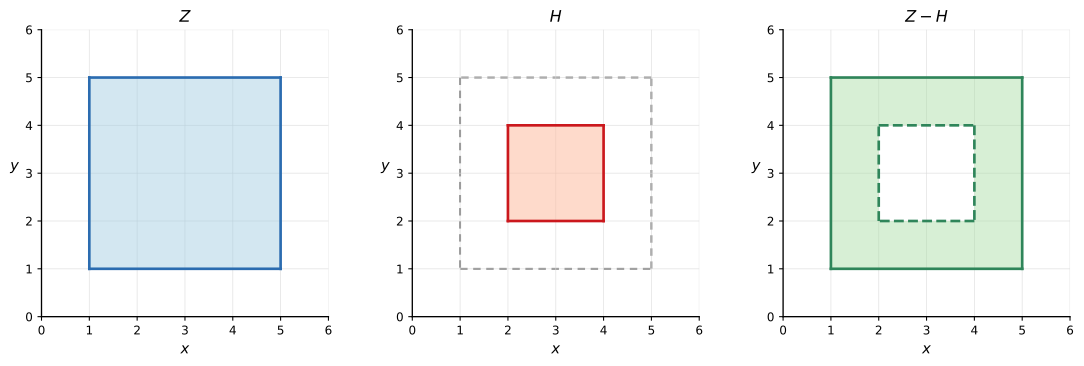
This is exactly the pressure described in the subtraction paper by David, Larsen, Lime, and Poulsen [DHLP06_FED]: once subtraction leaves the convex world, a single DBM is no longer a sufficient exact target.
In UDBM, the exact result therefore becomes a union of DBMs rather than one new matrix. In the current Python binding, the same example can be written directly:
from pyudbm import Context, IntValuation

c = Context(["x", "y"])
x = c.x
y = c.y

outer = (x >= 1) & (x <= 5) & (y >= 1) & (y <= 5)
hole = (x >= 2) & (x <= 4) & (y >= 2) & (y <= 4)
ring = outer - hole

assert ring.get_size() == 4

inside = IntValuation(c)
inside["x"] = 1
inside["y"] = 1

removed = IntValuation(c)
removed["x"] = 3
removed["y"] = 3

assert ring.contains(inside)
assert not ring.contains(removed)
Mathematically, that means
with each \(D_i\) still an ordinary convex DBM zone.
What A Federation Means In UDBM
A federation is not a mysterious new constraint language. It is a finite union of ordinary DBM zones:
where every \(D_i\) is still one convex DBM.
That design choice matters for two reasons.
First, it preserves the DBM machinery instead of replacing it. The algorithms for closure, relation checks, delay, reset, and containment still operate at the DBM level; the federation layer lifts them to finite unions [UDBM_FED_H] [UDBM_FED_CPP].
Second, it keeps non-convex symbolic states exact. In the native code, this is
the job of fed_t in fed.h / fed.cpp. The implementation is not a
diagram structure like a CDD. It is an explicit federation layer with set
operations, subtraction, reduction, predecessor-style operators, and relation
checks on unions of DBMs [DHLP06_FED] [BEHR03_CDD].
What Federations Can Do
The current Federation operations and properties can be grouped like this:
This table focuses on the semantics-facing Federation surface currently
exposed by the Python binding. It intentionally excludes object-infrastructure
helpers such as copy(), plot(), textual rendering, and hashing.
API |
Kind |
Semantics |
Mutation Style |
Jump To Details |
|---|---|---|---|---|
|
Representation |
Exact |
Returns snapshots |
|
|
Representation |
Exact |
Query only |
|
|
Set operation |
Exact |
Returns new federation |
|
|
Set operation |
Exact |
Returns new federation |
|
|
Set operation |
Convex over-approximation |
Returns new federation |
|
|
Set operation |
Exact |
Returns new federation |
|
|
Time transform |
Exact |
Returns new federation |
|
|
Time transform |
Exact |
Returns new federation |
|
|
Clock transform |
Exact |
Returns new federation |
|
|
Re-initialization |
Exact |
Mutates |
|
|
Property |
Exact |
Query only |
|
|
Re-initialization |
Exact |
Mutates |
Re-initializing To The Positive Initial Zone With set_init() |
|
Shape transform |
Convex over-approximation |
Returns new federation |
|
|
Relation |
Exact |
Query only |
|
|
Relation |
Exact |
Query only |
|
|
Representation maintenance |
Geometry-preserving |
Mutates internal sharing state |
|
|
Temporal transform |
Exact |
Returns new federation |
|
|
Membership |
Exact |
Query only |
|
|
Clock assignment |
Exact |
Returns new federation |
Updating And Resetting Clocks: update_value() And reset_value() |
|
Clock assignment |
Exact |
Returns new federation |
Updating And Resetting Clocks: update_value() And reset_value() |
|
Representation maintenance |
Geometry-preserving |
Mutates |
|
|
Abstraction |
Over-approximation |
Returns new federation |
|
|
Property |
Exact |
Query only |
|
|
Property |
Exact |
Query only |
Representation And Structural Queries
Decomposing A Federation With to_dbm_list()
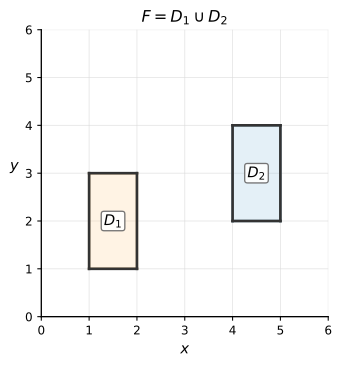
The most direct way to see what a federation is internally is to export its DBM pieces:
from pyudbm import Context

c = Context(["x", "y"])
x = c.x
y = c.y

fed = ((x >= 1) & (x <= 2) & (y >= 1) & (y <= 3)) | ((x >= 4) & (x <= 5) & (y >= 2) & (y <= 4))
pieces = fed.to_dbm_list()
piece_texts = sorted(dbm.to_string() for dbm in pieces)

assert len(pieces) == 2
assert piece_texts == [
    "(1<=x & 1<=y & x<=2 & y<=3)",  # D1
    "(4<=x & 2<=y & x<=5 & y<=4)",  # D2
]
This is exact representation inspection, not approximation. It is especially
useful when subtraction or exact union has produced several convex pieces.
In this example the strings make the two pieces explicit: D1 is the left
rectangle and D2 is the right one. The sort step is only there so the
example does not depend on internal list ordering.
Counting Pieces With get_size()
The same decomposition figure also explains get_size():
assert fed.get_size() == 2
get_size() counts native DBMs, not visible edges, constraints, or vertices.
So its meaning is representational: how many convex components are currently
stored in the federation.
Representation Quality: reduce() And intern()
Federations are not only about set semantics. Once many DBMs accumulate, their representation quality starts to matter too:
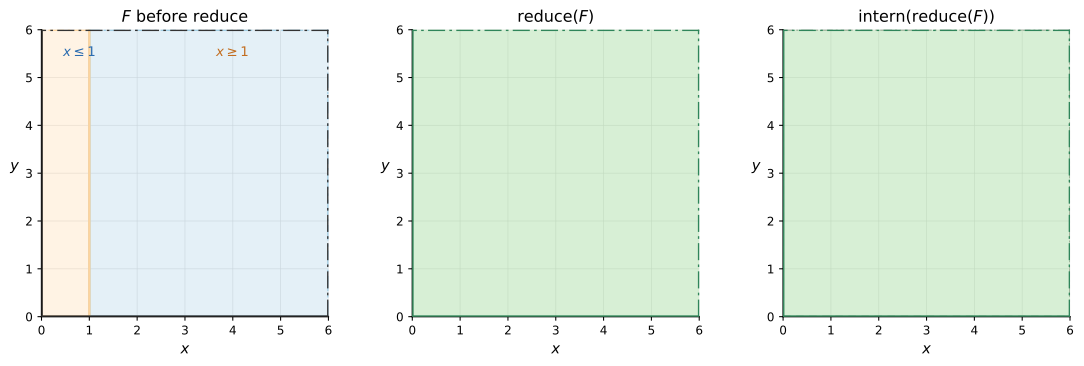
reduce() can simplify a structurally awkward federation without changing
its geometry. A compact example is x <= 1 | x >= 1: the left panel stores
that set as two DBMs, while the middle panel shows the same region after it has
been reduced to one canonical piece:
complex_fed = (x <= 1) | (x >= 1)
assert complex_fed.get_size() == 2

complex_fed.reduce()
assert complex_fed.get_size() == 1
assert complex_fed == (x >= 0)
intern() is different. It is not a geometric or semantic transformation at
all. It asks UDBM to share equal canonical DBMs internally through its hash
tables:
complex_fed.intern()
assert complex_fed.get_size() == 1
assert complex_fed == (x >= 0)
So the right mental split is:
reduce()tries to improve the visible DBM listintern()tries to improve internal sharing and equality costsneither is supposed to change the symbolic set
Set Operations
Exact Intersection &
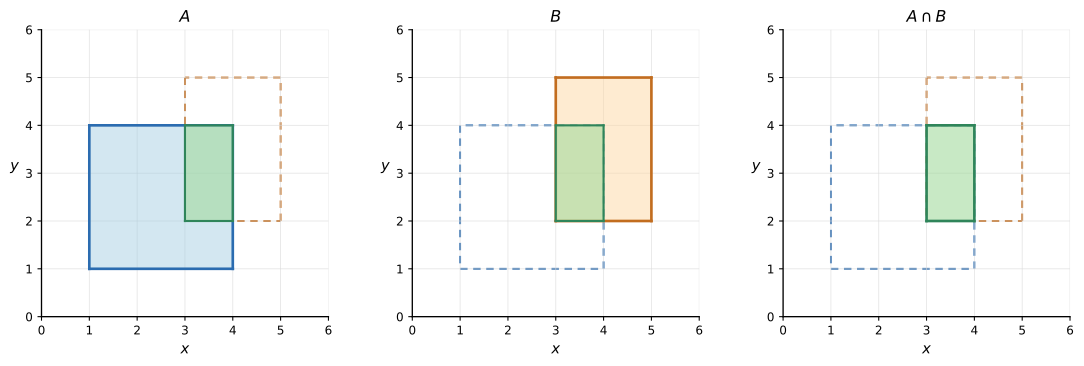
Intersection stays inside the exact symbolic world:
left = (x >= 1) & (x <= 4) & (y >= 1) & (y <= 4)
right = (x >= 3) & (x <= 5) & (y >= 2) & (y <= 5)
exact_intersection = left & right
The first two panels already overlay the other operand, so the overlapping
corner is visible before you even look at the result. In the last panel, A
and B stay as dashed references and the filled area is exactly A & B.
The result is exact and usually still convex enough to fit into one DBM.
Exact Union |
Exact union keeps all pieces and keeps all gaps:
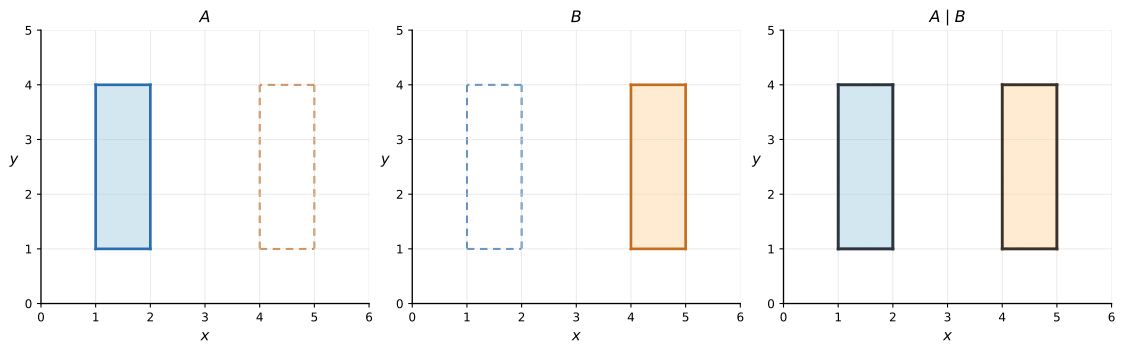
The result panel keeps the two convex pieces separate, so the gap remains part of the geometry:
exact = a | b
This is the natural federation-building operation when symbolic branching or subtraction has produced multiple exact components.
Convex Union +
+ is not the same as |. It computes UDBM’s convex-union style
addition:
hull_like = a + b
For the separated example in the figure, that fills the gap and introduces new
valuations. So + is already an over-approximation-style operation, not a
plain exact set union.
This distinction between | and + is exactly where the geometric
difference between exact union and convex hull-like combination belongs:
the left panel keeps the gap, the right panel fills it. Federation support is
therefore not just “store several DBMs in one object”; different operators
really do have different symbolic meanings.
Exact Difference -
Subtraction is the cleanest place where one DBM stops being enough, which is why it already appeared in the tutorial motivation above. At the API level the same idea is simply:
ring = outer - hole
Transformations On Federations
Delay Successor up()
up() lifts the usual DBM delay successor to every DBM in the federation:
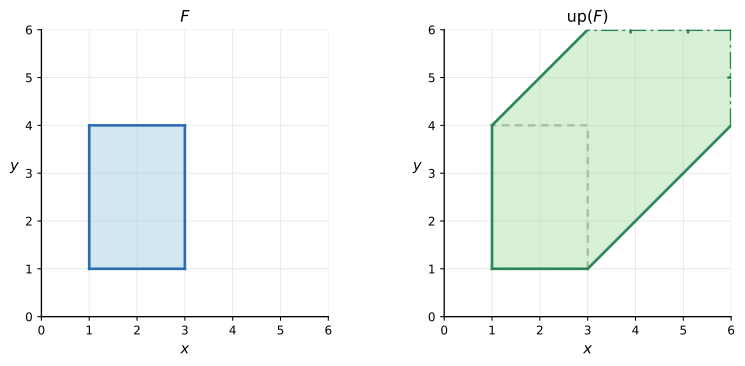
delayed = fed.up()
Semantically, upper bounds against the zero clock are relaxed so time can elapse.
Inverse Delay down()
down() is the temporal predecessor counterpart:
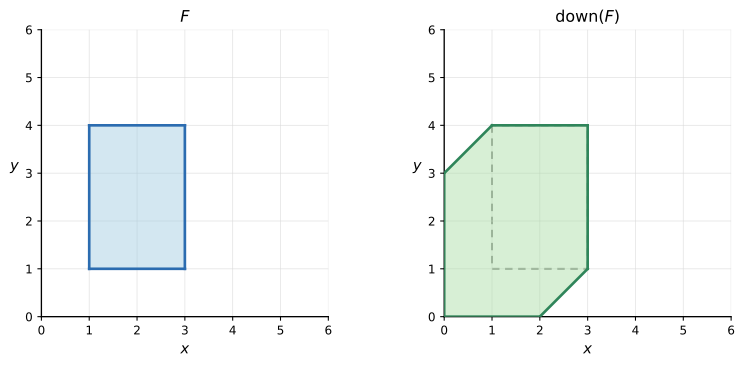
predecessor = fed.down()
This relaxes lower bounds so that delaying can lead into the current federation.
Forgetting One Clock With free_clock()
Freeing a clock removes the informative constraints involving it:
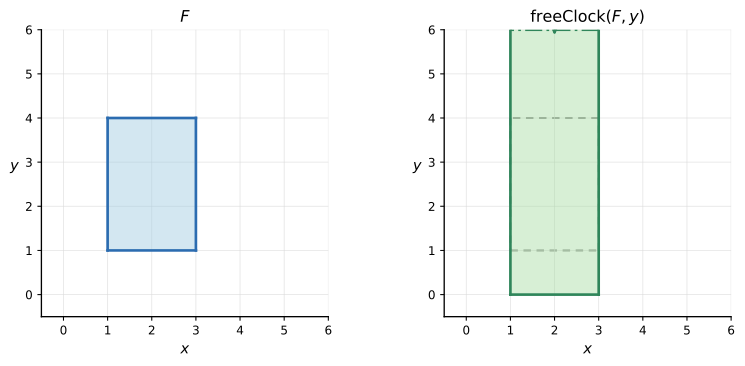
freed = fed.free_clock(y)
Geometrically, this often turns a bounded shape into a strip or half-space.
Re-initializing To The Origin With set_zero()
set_zero() mutates the federation into the single origin valuation:
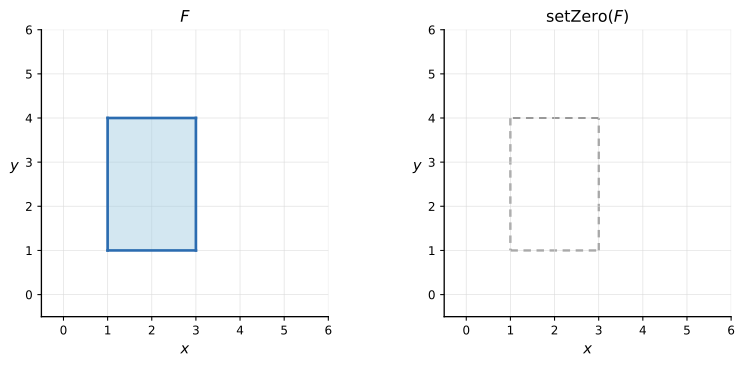
zone.set_zero()
assert zone.has_zero()
This is exact, not symbolic shorthand.
Re-initializing To The Positive Initial Zone With set_init()
set_init() replaces the current federation by the standard non-negative
initial zone:
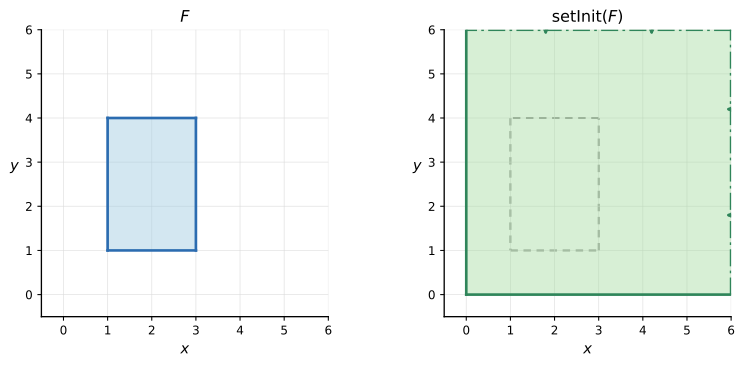
zone.set_init()
assert str(zone) == "true"
This is the UDBM-style “all clocks are non-negative, otherwise unconstrained” initial symbolic state.
Convex Hull With convex_hull()
convex_hull() works on one federation and computes one convex
over-approximation:
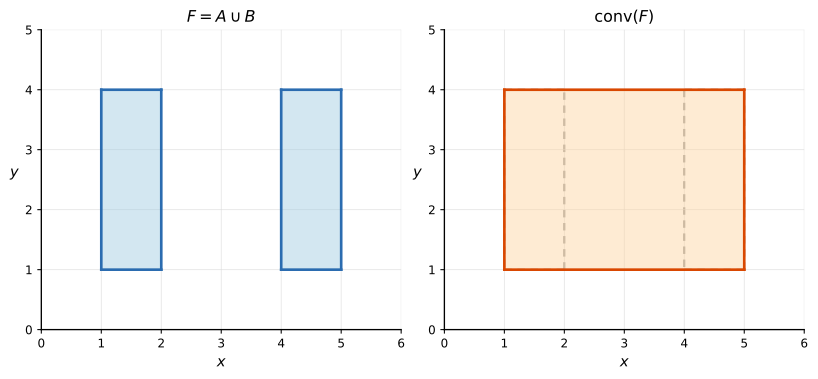
hull = exact.convex_hull()
This differs from + only in arity and use style:
a + bcombines two arguments by convex unionf.convex_hull()hulls all DBMs already inside one federation
Temporal Predecessor predt()
predt() computes states that may delay into a good region while avoiding a
bad one:
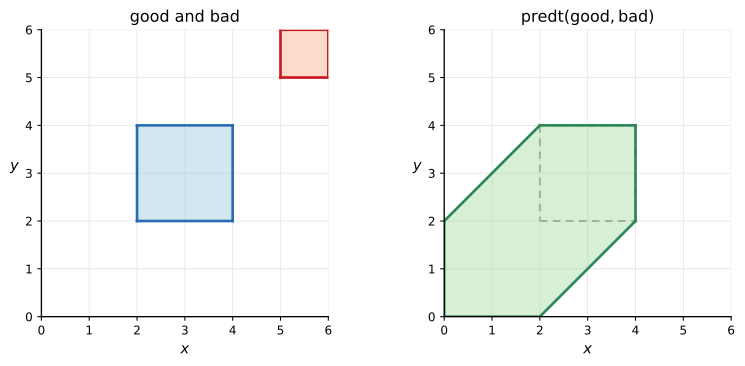
pred = good.predt(bad)
This is one of the places where the federation layer clearly behaves like a symbolic-state engine rather than only a container of matrices.
Updating And Resetting Clocks: update_value() And reset_value()
Both operations assign one clock a concrete value:
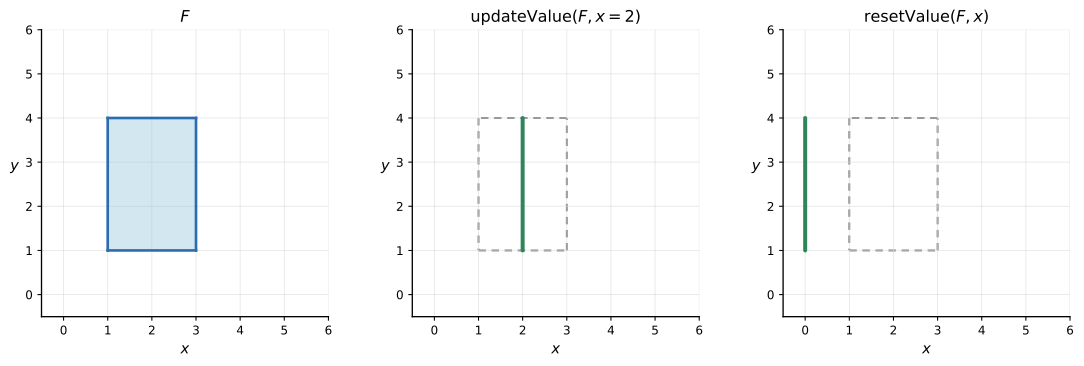
updated = fed.update_value(x, 2)
reset = fed.reset_value(x)
reset_value(clock) is just the 0-specialized case of
update_value(clock, value).
Max-Bound Extrapolation extrapolate_max_bounds()
Extrapolation is where the tutorial leaves exact symbolic semantics and enters abstraction for termination:
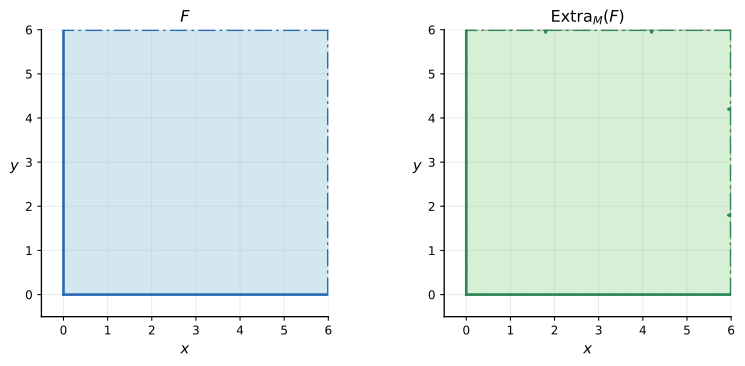
abstracted = fed.extrapolate_max_bounds({"x": 100, "y": 100})
The point is not to preserve the exact original federation. The point is to drop constraints that exceed the maximal constants and keep the analysis finite [UDBM_FED_H].
Queries And Properties
Containment contains()
The properties figure contains a direct membership picture:
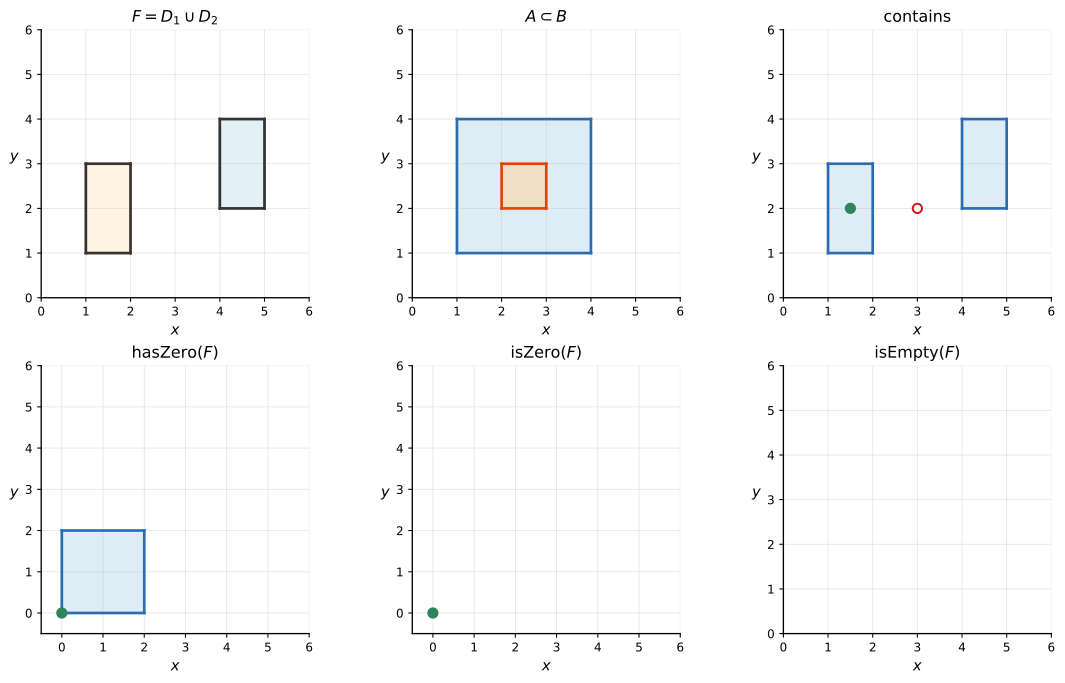
In the contains panel, one point lies inside the federation and one lies in
the gap:
assert fed.contains(inside_point)
assert not fed.contains(outside_point)
This is valuation membership in the most literal sense.
Zero-Point Queries: has_zero() And is_zero()
The same figure distinguishes two related but different questions:
has_zero()asks whether the origin belongs to the federation at allis_zero()asks whether the whole federation is exactly the origin zone
That is why the hasZero panel still shows a nontrivial region, while the
isZero panel collapses to the single point \((0,0)\).
Empty Federations With is_empty()
The last panel of the properties figure illustrates the empty case. This is the result of contradictory constraints, for example:
empty = (x == 1) & (x != 1)
assert empty.is_empty()
Relations: ==, !=, <=, >=, <, >
The six comparison operators deserve their own gallery:
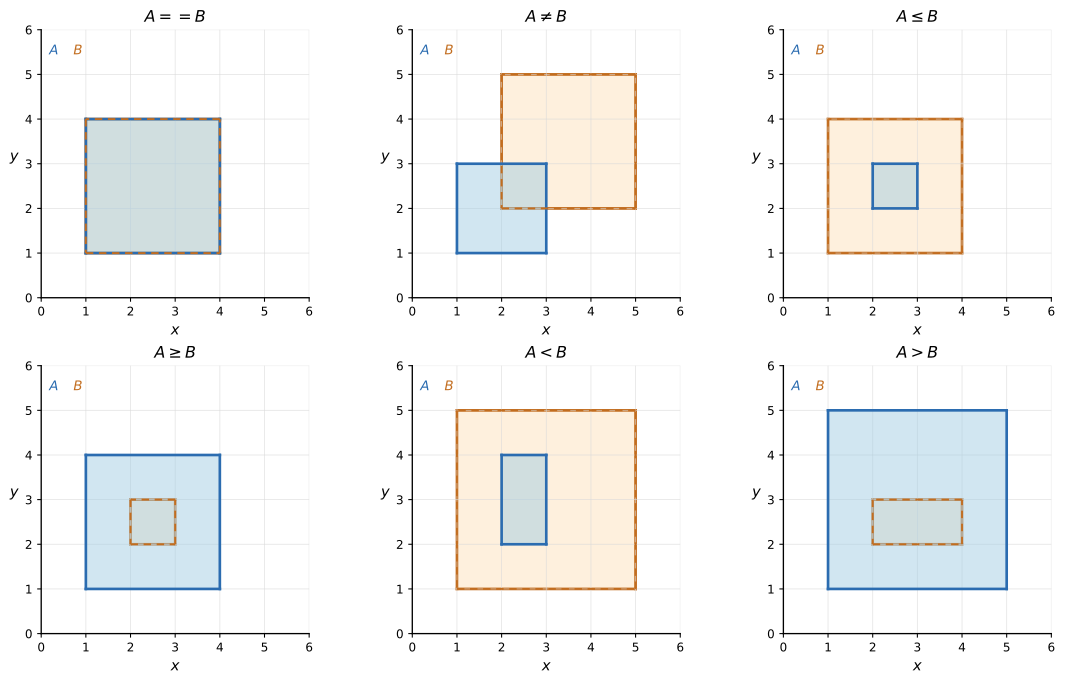
Each panel shows one representative witness. For the non-strict operators
<= and >=, equality would also be allowed even though the pictured
example uses proper containment.
A == Bmeans same symbolic setA != Bmeans different symbolic setsA <= Bmeans subsetA >= Bmeans supersetA < Bmeans strict subsetA > Bmeans strict superset
In other words, the comparison operators on federations are set-theoretic, not lexical or object-identity based.
Important Takeaways
Several distinctions matter a lot in practice:
A federation is still built from DBMs. It does not replace DBMs; it sits one layer above them.
Subtraction is where federations stop looking optional. Non-convex results are a semantic fact, not a UI choice.
Exact union and convex union are different operations. They should not be explained as if one were just a faster version of the other.
Reduction and interning are about representation quality. They matter because federation size and internal sharing affect later symbolic work.
Extrapolation is not an exact transform. It is an intentional abstraction step.
The public Python surface follows the native semantic layer closely. This is why the restored API has to center on
Federationrather than only on one DBM at a time.
Next
The next natural topic after federations is CDD Basics: How Shared Decision Graphs Compress Non-Convex Symbolic Sets: once finite unions of zones become first-class, the next question is whether an explicit list of DBMs is always the best representation, or whether shared diagram structures sometimes compress the same symbolic set better.
References
Alexandre David, Kim G. Larsen, Didier Lime, and Brian H. Poulsen.
Subtracting Clock Zones.
Public link: https://homes.cs.aau.dk/~adavid/dhlp06-zones.pdf.
Repository guide: https://github.com/HansBug/pyudbm/blob/main/papers/dhlp06/README.md.
Gerd Behrmann.
Efficient Timed Reachability Analysis using Clock Difference Diagrams.
Public link: https://www.brics.dk/RS/98/47/BRICS-RS-98-47.pdf.
Repository guide: https://github.com/HansBug/pyudbm/blob/main/papers/behrmann03/paper-c/README.md.
UPPAALModelChecker.
UDBM/include/dbm/fed.h.
Public link: https://github.com/UPPAALModelChecker/UDBM/blob/d83b703126fb88b3565c71cca68e360227dfb192/include/dbm/fed.h.
UPPAALModelChecker.
UDBM/src/fed.cpp.
Public link: https://github.com/UPPAALModelChecker/UDBM/blob/d83b703126fb88b3565c71cca68e360227dfb192/src/fed.cpp.