DBM Basics
This page answers the next question after Symbolic States and Zones: if a zone is a set of valuations, why can a matrix represent it at all?
For UPPAAL-style symbolic verification, the answer is a very specific one: a difference bound matrix (DBM) stores upper bounds on pairwise clock differences. That is exactly expressive enough for the guard and invariant language used in timed automata, and it supports the core symbolic operations that UDBM exposes in practice [UPP_VER_DBM] [BY04_DBM] [BENG02_DBM] [UDBM_REPO].
Representation, Encoding, And Design Intuition
The Running Zone
Start from one concrete convex zone over clocks x and y:
This is still a geometric object: it is a set of valuations satisfying several constraints simultaneously.
The key DBM move is to add the zero clock \(x_0\), which is always equal to 0. Then ordinary lower and upper bounds become difference constraints too:
\(x \leq 5\) becomes \(x - x_0 \leq 5\)
\(x \geq 0\) becomes \(x_0 - x \leq 0\)
\(y \leq 3\) becomes \(y - x_0 \leq 3\)
\(y \geq 0\) becomes \(x_0 - y \leq 0\)
\(x - y \leq 2\) already has the right shape
Once everything has the shape “clock minus clock is bounded above”, a matrix is exactly the natural container.
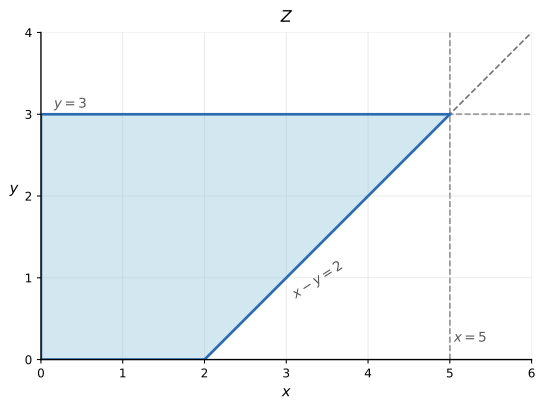
On the plane, the same zone is visually straightforward. The figure below is deliberately language-neutral: it only shows the \(x\) / \(y\) axes, the relevant boundary lines, and the filled feasible region for \(0 \leq y \leq 3,\; 0 \leq x \leq 5,\; x - y \leq 2\):
If we fix the clock order as \((x_0, x, y)\), the running example can be written directly as the DBM
Each cell still uses the same pair notation. For example:
the entry \((\leq, 2)\) in row
xand columnymeans \(x - y \leq 2\)the entry \((\leq, 3)\) in row
yand columnxmeans \(y - x \leq 3\)the entry \((\leq, 5)\) in row
xand columnx_0means \(x - x_0 \leq 5\)
The Core Encoding Idea
For clocks \(x_0, x_1, \ldots, x_n\), a DBM stores entries
meaning that the represented zone requires
Here:
\(\triangleleft_{ij}\) is either \(<\) or \(\leq\)
\(c_{ij}\) is an integer bound
the pair therefore remembers both the number and whether the bound is strict
In tutorial prose, it is often enough to read \(D_{ij}\) simply as “the current upper bound on \(x_i - x_j\).”
Three entries from the running example are worth reading explicitly:
\(D_{x,x_0} = (\leq, 5)\) means \(x - x_0 \leq 5\), hence \(x \leq 5\)
\(D_{x_0,y} = (\leq, 0)\) means \(x_0 - y \leq 0\), hence \(y \geq 0\)
\(D_{x,y} = (\leq, 2)\) means \(x - y \leq 2\)
So a DBM is not “just any square table”. Its rows and columns are indexed by clocks, and each cell talks about one clock difference.
Using the same running example, the full matrix is
So what you are looking at is not “a table of numbers”, but a clock-indexed family of difference constraints.
What One Cell Stores In UDBM Code
At the mathematical level it is convenient to describe \(D_{ij}\) as the
pair \((\triangleleft_{ij}, c_{ij})\). In the actual UDBM code, however,
one DBM cell is stored as a single integer of type raw_t [UDBM_CONSTRAINTS].
The packing rule in constraints.h is:
with:
dbm_STRICT = 0for \(<\)dbm_WEAK = 1for \(\leq\)
So the low bit stores the comparator, and the remaining bits store the integer bound. Two small examples make this concrete:
dbm_bound2raw(5, dbm_STRICT) = 10encodes \(< 5\)dbm_bound2raw(5, dbm_WEAK) = 11encodes \(\leq 5\)
Decoding then uses the matching helpers:
dbm_raw2bound(raw)removes the low-bit strictness flagdbm_rawIsStrict(raw)checks whether the encoded comparator is \(<\)dbm_rawIsWeak(raw)checks whether it is \(\leq\)
This is why UDBM can do most DBM work with integer arithmetic directly instead
of carrying an explicit struct pair in every cell. The thin C++ wrapper in
dbm_raw.hpp exposes exactly this view through helpers such as at,
bound, is_strict, and is_weak [UDBM_RAW_HPP].
Infinity Is Part Of Real DBMs
Real DBMs do not consist only of small finite numbers. In actual symbolic exploration, many entries mean “there is no finite upper bound currently known.”
UDBM therefore treats infinity as a first-class encoded case:
dbm_INFINITYis the decoded integer-side sentineldbm_LS_INFINITYis the raw encoded value for \(< \infty\)
This detail matters. UDBM does not use \(\leq \infty\) as a normal DBM
cell. In fact, dbm_weakRaw explicitly refuses to weaken infinity, because
<= infinity is not the canonical representation used by the library
[UDBM_CONSTRAINTS].
That means a real DBM often looks more like this than like the fully finite example in the first figure:
This is essentially the shape created by dbm_init when CLOCKS_POSITIVE
is enabled: the first row and diagonal are <= 0, while the remaining cells
start as <INF [UDBM_DBM_H_CODE] [UDBM_DBM_C_CODE].
The same special value keeps appearing in ordinary operations too:
dbm_upremoves upper bounds by settingDBM(i, 0) = dbm_LS_INFINITYdbm_freeClockerases a clock’s informative row by filling it with infinity-like entriesdimension-changing and extrapolation code paths also use the same sentinel repeatedly
So any explanation of DBMs that pretends every entry is always a small finite number is leaving out an essential part of how the library really behaves.
Why The Zero Clock Matters
The zero clock is the trick that makes the representation uniform.
Without \(x_0 = 0\), there would be two different syntactic worlds:
ordinary bounds such as \(x \leq 5\)
difference bounds such as \(x - y \leq 2\)
With the zero clock, both become entries of the same matrix:
This uniformity is the whole reason DBMs are such a good fit:
one storage format covers lower bounds, upper bounds, and clock differences
one family of algorithms can update them
one graph interpretation can explain closure, emptiness, and relation checks
Graph View And Canonical Closure
Every DBM can also be read as a weighted directed graph:
vertices are clocks
edge \(i \to j\) stores the current upper bound on \(x_i - x_j\)
Under this reading, the canonical DBM is the one where every entry is already the tightest bound implied by all paths through the graph. That is exactly the triangle-inequality condition
interpreted with strictness handled in the obvious paired way [BY04_DBM] [BENG02_DBM].
![digraph dbm_closure_graph {
rankdir=LR;
graph [splines=true, nodesep=0.7, ranksep=0.8];
node [shape=circle, style="filled", fillcolor="#f8f8f8", color="#666666", width=0.8];
x0 [label="x0"];
x [label="x"];
y [label="y"];
x -> x0 [label="x - x0 <= 5"];
x0 -> x [label="x0 - x <= 0"];
y -> x0 [label="y - x0 <= 3"];
x0 -> y [label="x0 - y <= 0"];
x -> y [label="closure: x - y <= 5", color="#3f6fb5", fontcolor="#3f6fb5", style="dashed"];
y -> x [label="closure: y - x <= 3", color="#3f6fb5", fontcolor="#3f6fb5", style="dashed"];
note [shape=box, style="rounded,filled", fillcolor="#eef6ff", color="#4f81bd",
label="Canonical closure makes every entry\nthe tightest bound implied by all paths."];
y -> note [arrowhead=none, style=invis];
}](../../_images/graphviz-3f04cbcc2dc86da6066db3d3779ccdf96ed818db.png)
The dashed edges in the picture are not new user-written constraints. They are constraints that become explicit once closure computes the shortest implied paths.
This is why canonical closure is a core invariant rather than an optional cleanup step:
it makes different but equivalent DBMs collapse to the same normal form
it makes relation checks and updates much easier to reason about
it lets the library treat each entry as a genuine tight summary, not just a raw hint
How To Read Canonical Closure In UDBM Source
If you only look at the graph picture, canonical closure can sound like “cleanup after the real work.” The UDBM source makes the intent much sharper: it is a Floyd-style shortest-path propagation over the DBM graph.
The comment on dbm_close in dbm.h is explicit about this: for each
intermediate clock \(k\), it checks whether
and, if so, tightens \(D_{ij}\) to the better value [UDBM_DBM_H_CODE].
The implementation in dbm.c follows that shape directly:
the outer loop iterates over the intermediate clock
kthe inner loops walk rows
iand columnsjno update is attempted when either side of the path is
dbm_LS_INFINITYthe diagonal is checked during the process, not only afterwards
That last point matters. If the code discovers dbm[i,i] < dbm_LE_ZERO, it
returns empty immediately. Intuitively, the shortest-path propagation has just
derived a contradiction of the form
So the main thing to remember is simple: canonical closure is the shortest-path step that systematically pulls every indirectly implied tighter bound back into the matrix [UDBM_DBM_C_CODE].
Canonical Is Not The Same As Minimal
This point is easy to miss:
canonical means all implied shortest-path bounds are explicit
minimal means redundant constraints have been removed for storage or compact representation
So canonical closure often makes the matrix denser, not smaller. That is not a contradiction. Canonical form is the convenient form for symbolic manipulation; compact storage is a later, separate concern [BY04_DBM] [BENG02_DBM].
A concrete example makes the distinction much easier to see. Consider two ordinary clocks \(x,y\) plus the reference clock \(x_0 = 0\). Suppose the intended zone is just the rectangle
Now start from a non-canonical description that explicitly stores
\(x - x_0 \leq 5\)
\(x_0 - x \leq 0\)
\(y - x_0 \leq 3\)
\(x_0 - y \leq 0\)
and even an extra loose constraint \(x - y \leq 10\)
This already describes the right set of valuations, but it is not canonical:
from \(x \leq 5\) and \(y \geq 0\), we can derive the tighter bound \(x - y \leq 5\)
the stored entry \(x - y \leq 10\) is therefore too weak
from \(y \leq 3\) and \(x \geq 0\), we can also derive \(y - x \leq 3\)
even if that \(y - x\) entry was missing before, canonical closure will make it explicit
If we fix the clock order as \((x_0, x, y)\) and write each matrix entry as \((\triangleleft, c)\) to mean \(x_i - x_j \triangleleft c\), then one possible non-canonical starting matrix is
Here the entry \((<, \infty)\) in the last row and second column says that we initially stored no finite upper bound for \(y - x\); the entry \((\leq, 10)\) in the second row and third column is the deliberately loose constraint \(x - y \leq 10\).
After canonical closure, the DBM becomes the form where every implied tightest bound is written into the matrix. In this example, the key changes are:
\(x - y \leq 10\) is tightened to \(x - y \leq 5\)
the previously implicit \(y - x \leq 3\) becomes explicit
diagonal and other path-implied entries are uniformly tightened as well
After canonical closure, the explicit canonical form becomes
Every entry now matches the tightest implied upper bound:
\(D_{10} = (\leq, 5)\) means \(x - x_0 \leq 5\)
\(D_{01} = (\leq, 0)\) means \(x_0 - x \leq 0\), i.e. \(x \geq 0\)
\(D_{12} = (\leq, 5)\) means \(x - y \leq 5\)
\(D_{21} = (\leq, 3)\) means \(y - x \leq 3\)
In this example all tight bounds are non-strict, so every finite canonical
entry uses \leq. If the zone had included a strict constraint such as
\(x < 5\) or \(x - y < 2\), the corresponding entry would instead be
\((<, 5)\) or \((<, 2)\).
But if we instead ask, “what is the smallest constraint set that still defines the same zone?”, the answer is different. A minimal constraint set here can keep only
\(0 \leq x \leq 5\)
\(0 \leq y \leq 3\)
because
\(x - y \leq 5\) is explicit in canonical form, but still derivable from those box constraints
\(y - x \leq 3\) is derivable for the same reason
the original loose bound \(x - y \leq 10\) belongs to neither the canonical tight form nor the minimal representation
So the relationship is:
the original representation may omit some implied constraints or store some entries too loosely
the canonical form makes all tight implied constraints explicit, so it is usually more complete and denser
the minimal constraint set removes constraints that are semantically derivable and therefore unnecessary to store, so it is usually sparser
That is why “canonicalization” and “minimization” move in opposite directions: the former completes the tight semantic information, while the latter removes representational redundancy.
Core Operations On DBMs
The real value of DBMs is not only that they store zones. It is that they support the exact symbolic operations a verifier repeatedly needs.
Intersection And Constraining
Adding a new guard means intersecting the current zone with another constraint.
For example, if the current zone additionally requires \(y \geq 1\), then we add
to the matrix, tighten the corresponding entry, and close again.
Operationally, this means:
every old valuation that still satisfies the new guard stays
every valuation violating the guard disappears
closure propagates the consequences to all other pairwise bounds
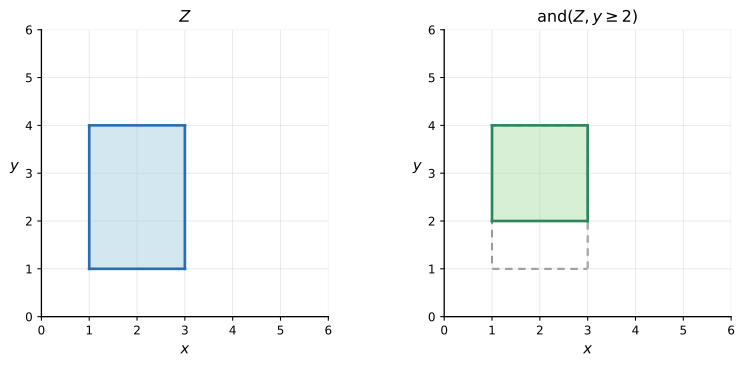
The before/after picture below makes that intersection concrete: the left panel is the input zone \(Z\), the right panel is the result after adding \(y \geq 2\), and the dashed outline keeps the original region visible for comparison:
In UDBM’s C API, this shows up as functions such as dbm_constrain and
dbm_constrain1 in dbm.h / dbm.c: they take a raw encoded
constraint, tighten the touched entries, and then rely on closure to finish the
propagation [UDBM_DBM_H_CODE] [UDBM_DBM_C_CODE].
Emptiness
Contradictions show up as impossible self-bounds after closure.
For example, combining \(x \leq 1\) with \(x \geq 3\) is equivalent to
and together they imply a negative loop on the diagonal. Intuitively, the graph would claim that \(x - x < 0\), which is impossible. That is how DBM emptiness checks become cheap and structural [BY04_DBM].
Delay: up
The future operation lets time pass while preserving the relative constraints that survive uniform clock growth.
Geometrically:
For DBMs this has a very characteristic effect:
absolute upper bounds such as \(x \leq 5\) may disappear
lower bounds and clock differences such as \(x - y \leq 2\) can remain relevant
So up does not mean “forget everything”. It means “keep exactly what still
matters after all clocks may advance together.”
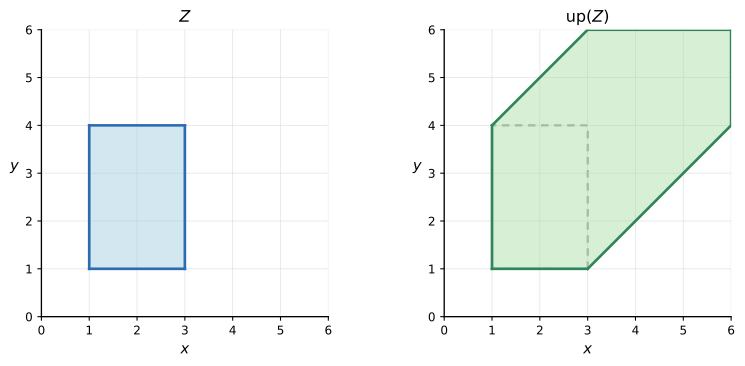
The figure below shows that geometric expansion directly: the left panel is the
original region, while the right panel shows the result of up inside the
same viewing window. You can see the absolute upper bounds disappear while the
surviving difference constraints still shape the zone:
In the actual UDBM implementation, dbm_up is strikingly literal: for each
non-reference clock it sets the cell DBM(i, 0) to dbm_LS_INFINITY.
That is precisely the code-level meaning of “remove the upper bound
\(x_i - x_0 \leq c\)” [UDBM_DBM_C_CODE].
Past: down
The past operation asks for valuations that can reach the current zone by letting time pass.
Geometrically:
If up grows the zone into the future, down expands it backward toward
earlier valuations. In verification algorithms this is the natural dual used by
backward reasoning and predecessor-style operations.
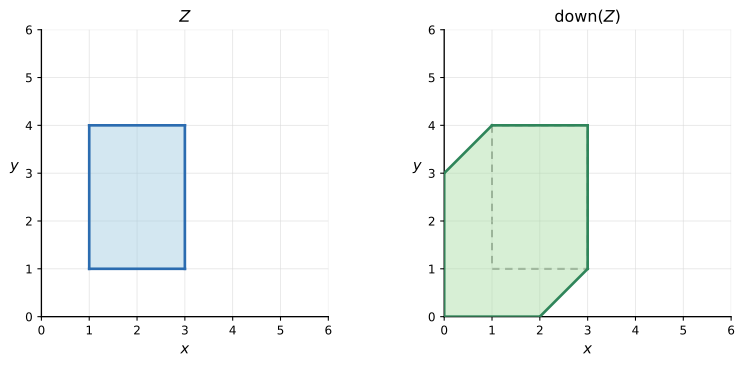
The corresponding geometric effect is shown below: the left panel is the input
zone, and the right panel shows how down expands it toward earlier
valuations in the same fixed viewing window:
Reset And Update
Timed-automata edges reset clocks. DBM operations handle that by rewriting one clock’s row and column relative to the zero clock and the remaining clocks.
For the common reset \(x := 0\), the new zone should satisfy
while all mixed constraints involving \(x\) are recomputed consistently.
More general updates such as \(x := c\) or value-copy style operations are variations on the same pattern: replace one clock’s relations, then re-close.
Geometrically, reset is easiest to read as “collapse the region onto a fixed clock value.” In the figure below, the green vertical segment in the right panel is the result after \(x := 2\), while the dashed outline still shows the old region:
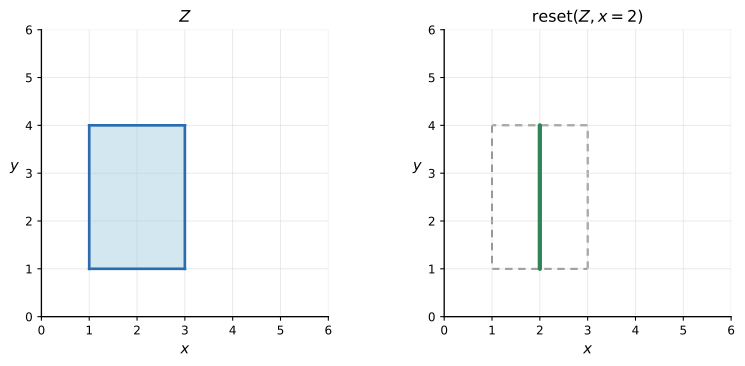
Again, the implementation is very direct. dbm_updateValue in dbm.c sets
DBM(k, 0) and DBM(0, k) to the weak encoded bounds for
\(x_k = c\), then rebuilds the rest of row k and column k using
raw-bound addition helpers such as dbm_addFiniteRaw and
dbm_addRawFinite [UDBM_DBM_C_CODE] [UDBM_CONSTRAINTS].
Freeing A Clock
Sometimes the algorithm wants to forget one clock almost entirely.
That is what free or freeClock style operations do:
remove the informative bounds involving that clock
keep only the trivial consistency requirements that every clock has with itself and with the zero clock
Semantically, this is a controlled abstraction: the resulting zone says “whatever the forgotten clock is, as long as the remaining constraints still make sense.”
That widening is visible geometrically too. In the figure below, the right panel shows the slice obtained after freeing one clock: the remaining constraints still shape the region, but the forgotten direction becomes much less constrained:
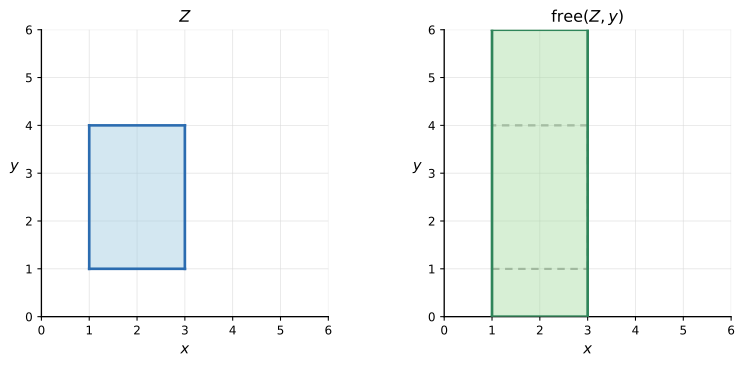
The code follows that idea closely. In dbm_freeClock, UDBM sets most cells
in the freed clock’s row to dbm_LS_INFINITY and rebuilds the column from
the reference-clock information, with a branch on CLOCKS_POSITIVE to decide
how much lower-bound information should survive [UDBM_DBM_C_CODE].
Containment And Equality
Once DBMs are canonical, relation checks become meaningful at the matrix level.
If one canonical DBM has bounds that are everywhere tighter than another, then it represents a smaller zone. This supports:
zone inclusion checks
equality checks up to semantic equivalence
hashing and sharing based on canonical content rather than on accidental syntax
Point Containment
A concrete valuation belongs to a DBM zone exactly when it satisfies every stored bound.
That makes point containment conceptually straightforward:
plug the valuation into each difference constraint
check whether all bounds hold
At the API level, this is the idea underneath valuation membership tests.
Positioning And Takeaways
Important Properties To Keep Straight
Several distinctions matter a lot in practice:
One DBM represents one convex zone. If the symbolic set is non-convex, the discussion should move to Federations: Exact Unions Of DBM Zones, where exact unions of multiple DBMs are the actual topic.
Strictness is part of the data. \(x < 5\) and \(x \leq 5\) are different DBM entries.
Canonical closure is not optional bookkeeping. It is what makes the matrix semantically trustworthy.
Canonical does not mean storage-optimal. Compact storage is a separate later topic.
Normalization / extrapolation is not the same as ordinary closure. Closure preserves the exact zone; extrapolation deliberately over-approximates for termination.
Why UDBM Is The Direct Implementation Layer
This is exactly the level where UDBM lives most naturally.
The upstream UDBM project describes DBMs as the core data structure for clock
constraints and explicitly lists operations such as up, down, updates,
extrapolation, and relation checks [UDBM_REPO]. How exact unions of multiple
DBMs form the next layer of representation is left to
Federations: Exact Unions Of DBM Zones.
That is why the layering in this repository makes sense:
timed-automata semantics motivates zones
DBMs give zones an efficient exact representation
UDBM implements the primitive operations on that representation
pyudbm rebuilds a more natural Python-facing surface above it
What To Remember
If you keep five ideas from this page, keep these:
a DBM stores upper bounds on clock differences \(x_i - x_j\)
the zero clock lets ordinary lower and upper bounds fit into the same scheme
canonical closure means every entry is already the tightest implied bound
DBMs are useful because they support the core symbolic operations, not only because they store zones
one DBM still represents only one convex zone; once the result is non-convex, continue with Federations: Exact Unions Of DBM Zones
Next
The next page is Federations: Exact Unions Of DBM Zones: once one convex zone can be stored exactly, the next question is how multiple DBMs can represent a non-convex symbolic set without losing exactness.
UPPAAL official GUI documentation, Verifier.
Public link: https://docs.uppaal.org/gui-reference/verifier/.
UPPAALModelChecker.
UDBM: UPPAAL DBM Library.
Public link: https://github.com/UPPAALModelChecker/UDBM.
UPPAALModelChecker.
UDBM/include/dbm/constraints.h.
Public link: https://github.com/UPPAALModelChecker/UDBM/blob/d83b703126fb88b3565c71cca68e360227dfb192/include/dbm/constraints.h.
UPPAALModelChecker.
UDBM/include/dbm/dbm_raw.hpp.
Public link: https://github.com/UPPAALModelChecker/UDBM/blob/d83b703126fb88b3565c71cca68e360227dfb192/include/dbm/dbm_raw.hpp.
UPPAALModelChecker.
UDBM/include/dbm/dbm.h.
Public link: https://github.com/UPPAALModelChecker/UDBM/blob/d83b703126fb88b3565c71cca68e360227dfb192/include/dbm/dbm.h.
UPPAALModelChecker.
UDBM/src/dbm.c.
Public link: https://github.com/UPPAALModelChecker/UDBM/blob/d83b703126fb88b3565c71cca68e360227dfb192/src/dbm.c.
Johan Bengtsson and Wang Yi.
Timed Automata: Semantics, Algorithms and Tools.
Public link: https://uppaal.org/texts/by-lncs04.pdf.
Repository guide: https://github.com/HansBug/pyudbm/blob/main/papers/by04/README.md.
Johan Bengtsson.
Clocks, DBMs and States in Timed Systems.
Public link: https://www.cmi.ac.in/~madhavan/courses/acts2010/bengtsson-thesis-full.pdf.
Repository guide: https://github.com/HansBug/pyudbm/blob/main/papers/bengtsson02/README.md.
Embedded-paper guide: https://github.com/HansBug/pyudbm/blob/main/papers/bengtsson02/paper-a/README.md.